Accelerating Cloud-Native Engineering
Introduction
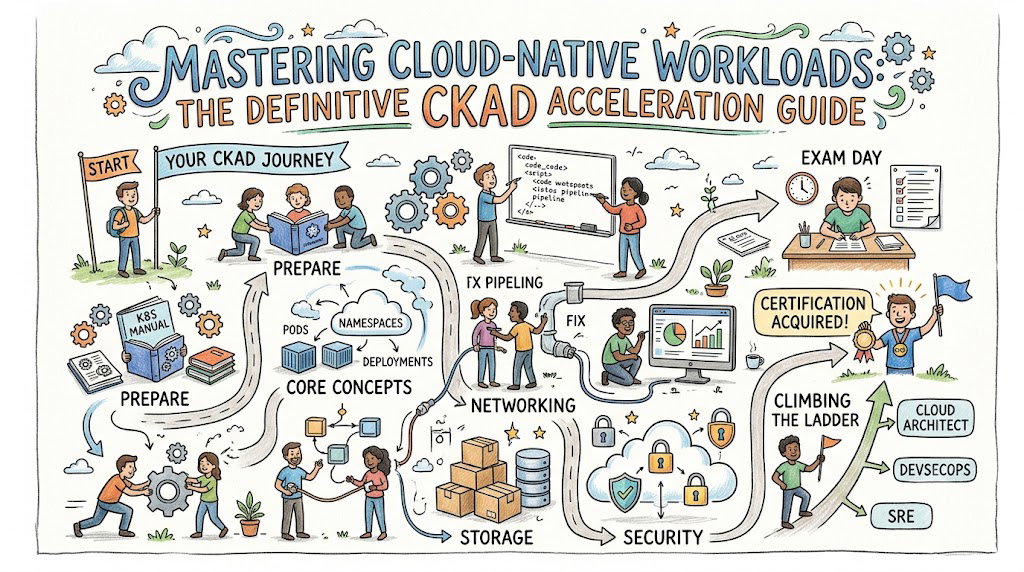
Navigating the modern software landscape requires a firm grasp of container orchestration, where microservices form the backbone of scalable applications. Tech professionals across the globe constantly seek reliable methods to validate their hands-on skills in managing these distributed systems. The Certified Kubernetes Application Developer (CKAD) certification serves as a definitive benchmark for engineering excellence in cloud-native deployment. This extensive roadmap provides developers, system administrators, and technology leaders with a strategic framework to approach the credential confidently. By focusing on practical application rather than passive memorization, the following sections outline the exact preparation strategies and industry pathways needed to elevate your cloud engineering career.
What is the Certified Kubernetes Application Developer (CKAD)?
The Cloud Native Computing Foundation (CNCF) created the Certified Kubernetes Application Developer (CKAD) program to establish a high global standard for container orchestration expertise. Instead of relying on traditional multiple-choice questions, this exam utilizes a live, performance-based command-line environment to evaluate technical competence. Candidates must actively build, configure, expose, and troubleshoot real workloads across multiple active Kubernetes clusters within a strict time limit. This rigorous testing method ensures that certified professionals possess the practical skills required to manage complex application rollouts, handle configuration data, and maintain system stability in live enterprise production environments.
Who Should Pursue Certified Kubernetes Application Developer (CKAD)?
Software developers, backend engineers, and cloud architects who actively deploy code into containerized environments gain massive competitive advantages from this program. Site Reliability Engineers (SREs), system administrators, and DevOps specialists also benefit significantly, as the curriculum directly addresses automated scaling and cluster interaction. Furthermore, security analysts, database administrators, and technical managers use this training to understand the infrastructure layer supporting their core applications. Whether you work within the fast-growing tech sectors of India or manage distributed engineering squads globally, this qualification establishes your operational capability to handle containerized applications efficiently.
Why Certified Kubernetes Application Developer (CKAD) is Valuable in and Beyond
As enterprise organizations shift away from monolithic architectures, Kubernetes has emerged as the universal standard for modern cloud infrastructure management. Earning a hands-on credential demonstrates to employers that you can construct resilient, self-healing application environments without depending on theoretical guesswork. The knowledge gained from this certification remains highly portable, since the core mechanics of pod design, network policies, and storage configurations apply equally across AWS, Google Cloud, and Microsoft Azure. Investing your time into this training ensures long-term career resilience by keeping your skills perfectly aligned with the technical demands of the enterprise market.
Certified Kubernetes Application Developer (CKAD) Certification Overview
The complete instructional path for this program runs via DevOpsSchool and maintains its primary digital home on DevOpsSchool. The assessment process drops candidates straight into an active terminal window, requiring the rapid execution of kubectl commands to solve complex infrastructure tasks. Examiners evaluate your proficiency in defining multi-container configurations, mapping persistent storage volumes, enforcing security context rules, and diagnosing application runtime failures under pressure. This operational focus guarantees that successful candidates can immediately step into production environments and solve real cloud-native delivery challenges.
Why Choose DevOpsSchool
DevOpsSchool delivers an exceptional training experience by combining comprehensive theoretical lectures with extensive, immersive laboratory environments led by veteran industry specialists. The platform features robust sandbox networks that replicate the exact configuration challenges, multi-cluster environments, and time constraints found in the official CNCF testing arena. Students receive step-by-step mentoring, updated study materials, custom mock examinations, and ongoing community support to ensure they achieve complete command-line fluency. This practical approach enables engineering professionals to transition smoothly from basic container concepts to advanced cloud-native deployment mastery.
Certified Kubernetes Application Developer (CKAD) Certification Tracks & Levels
Building deep expertise in cloud-native application deployment requires a structured progression through distinct technical milestones.
- Foundation Level: Introduces the fundamental building blocks of containerization, including Docker architecture, basic Linux commands, core namespace isolation, and simple pod creation.
- Professional Level: Focuses on the core certification domains where developers master deployment controllers, multi-container patterns, application configuration objects, and persistent data storage.
- Advanced Level: Challenges experienced engineers with complex microservice troubleshooting, custom resource definitions, Helm chart deployments, and fully automated continuous delivery pipelines.
Complete Certified Kubernetes Application Developer (CKAD) Certification Table
| Track | Level | Who it’s for | Prerequisites | Skills Covered | Recommended Order |
| Infrastructure & Code | Foundation | Associate Developers, QA Specialists | Linux Fundamentals, Container Basics | Pod Basics, Containers, Namespaces | First |
| Infrastructure & Code | Professional | Cloud Engineers, Systems Developers | YAML Configuration, Basic Docker | Deployments, Services, Storage, ConfigMaps | Second |
| Infrastructure & Code | Advanced | Senior SREs, Platform Architects | Professional Certification, Networking | Complex Debugging, Helm, CI/CD Integration | Third |
Detailed Guide for Each Certified Kubernetes Application Developer (CKAD) Certification
Certified Kubernetes Application Developer (CKAD) - Professional Application Developer
What it is
This credential certifies that an engineer can successfully design, build, and configure enterprise-grade applications inside a live Kubernetes environment, demonstrating operational readiness for cloud-native development.
Who should take it
Application developers, systems engineers, and infrastructure automation specialists who want to run highly available workloads on container clusters should pursue this exam.
Skills you'll gain
- Generating precise YAML configuration manifests using imperative commands.
- Binding persistent data storage elements to stateful container applications.
- Enforcing security profiles and access controls at the pod level.
- Separating environmental variables from application code using ConfigMaps and Secrets.
- Pinpointing and resolving application failures using cluster diagnostic logs.
Real-world projects you should be able to do
- Orchestrate a secure multi-container deployment that utilizes an automated sidecar logger.
- Update a critical production microservice using zero-downtime rolling update strategies.
- Embed custom liveness and readiness diagnostics to allow automated application self-healing.
Preparation plan
- 7 to 14 days: Train your muscle memory on imperative kubectl commands to bypass manual YAML editing completely.
- 30 days: Build out diverse laboratory scenarios focusing on complex network policies, volume mounts, and secret injections.
- 60 days: Complete multiple full-length, timed mock exams to verify your speed and troubleshooting agility under strict testing conditions.
Common mistakes
- Wasting valuable exam minutes writing complex resource manifests from scratch instead of running dry-run flags.
- Neglecting to check your active cluster context and target namespace before creating resources.
- Spending excessive time trying to solve a single confusing prompt instead of collecting points from simpler tasks.
Best next certification after this
- Same-track option: Certified Kubernetes Administrator (CKA)
- Cross-track option: Certified Kubernetes Security Specialist (CKS)
- Leadership option: Cloud Native Certified Architect (CNCA)
Choose Your Learning Path
DevOps Path
Engineers on this track focus entirely on automating the delivery lifecycle of containerized enterprise applications. You will learn to construct robust continuous integration pipelines, manage automated container image creation, and execute advanced deployment strategies like canary rollouts to minimize production risks.
DevSecOps Path
This specialization embeds security principles directly into every phase of the cloud-native design cycle. Security practitioners learn to enforce strict pod security standards, encapsulate sensitive API keys within secure Secrets, build isolation barriers using Network Policies, and eliminate image vulnerabilities before cluster entry.
SRE Path
Site Reliability Engineers prioritize system uptime, resource efficiency, and infrastructure visibility across production clusters. This curriculum teaches you to establish correct application resource limits, implement horizontal pod autoscaling rules, configure cluster monitoring platforms, and build self-healing automation routines.
AIOps Path
Professionals on this pathway combine algorithmic intelligence with automated cluster management to optimize ongoing system operations. You will implement predictive analytics tools that scan cluster log streams, forecast capacity requirements, and trigger preventative remediation actions without manual human intervention.
MLOps Path
This specialty addresses the complex infrastructure demands of hosting large-scale machine learning workflows on distributed clusters. Developers learn to orchestrate data pipeline steps, configure GPU acceleration hardware for specific container workloads, and scale model endpoints dynamically to handle shifting user traffic.
DataOps Path
Data automation specialists master the art of running stateful big data workflows and high-performance databases inside container clusters. You will learn to configure dynamic persistent storage systems, maintain high availability using StatefulSets, and manage distributed processing frameworks like Apache Spark.
FinOps Path
This track teaches engineers to balance technical scalability with strict cloud infrastructure cost control. Participants learn to monitor cluster compute spend using specialized tools, eliminate wasted capacity by right-sizing pod resource requests, and establish clear corporate cost-allocation tags.
Role → Recommended Certifications
| Role | Recommended Certifications |
| DevOps Engineer | Certified Kubernetes Application Developer, Certified Kubernetes Administrator |
| SRE | Certified Kubernetes Application Developer, Certified Kubernetes Administrator |
| Platform Engineer | Certified Kubernetes Application Developer, Certified Kubernetes Administrator, Certified Kubernetes Security Specialist |
| Cloud Engineer | Certified Kubernetes Application Developer, Cloud Provider Associate Certifications |
| Security Engineer | Certified Kubernetes Application Developer, Certified Kubernetes Security Specialist |
| Data Engineer | Certified Kubernetes Application Developer, Apache Spark Developer |
| FinOps Practitioner | Certified Kubernetes Application Developer, FinOps Certified Practitioner |
| Engineering Manager | Certified Kubernetes Application Developer, Certified Kubernetes Administrator |
Next Certifications to Take After Certified Kubernetes Application Developer (CKAD)
Same Track Progression
Progressing directly to the Certified Kubernetes Administrator (CKA) exam represents the most logical next step for application developers. This change moves your career focus from application hosting to core cluster management, giving you the practical skills required to bootstrap new clusters from scratch, handle node updates, and manage control plane networks.
Cross-Track Expansion
Broadening your architectural capabilities requires pursuing security-focused certifications like the Certified Kubernetes Security Specialist (CKS) or diving into platform-specific cloud architect certifications. This expansion helps you master cloud-native perimeter security, hybrid system integrations, and multi-region infrastructure setups that support enterprise resilience.
Leadership & Management Track
Transitioning toward strategic leadership roles like Director of Platform Engineering or Cloud Architect requires advanced enterprise certifications. These programs focus heavily on large-scale digital transformation methodologies, cloud financial planning, corporate governance frameworks, and technical team leadership strategies.
Training & Certification Support Providers for Certified Kubernetes Application Developer (CKAD)
The Core Platform Authority
DevOpsSchool commands immense respect as a global educational powerhouse within the cloud-native ecosystem, offering intensive, mentor-led programs that build real engineering capability. Their training modules perfectly balance architectural theory with rigorous, hands-on terminal laboratories to ensure every student develops practical competency in cloud automation. By tracking the latest open-source developments and maintaining deep ties with enterprise platforms, they prepare technology professionals to confidently handle complex production systems.Cotocus delivers specialized corporate bootcamps that focus on modern container workflows, helping engineering teams accelerate their migration timelines and modernize legacy application stacks.Scmgalaxy maintains an active community repository that provides comprehensive practice guides, configuration tutorials, and mock labs to help candidates pass performance-based testing.BestDevOps structures high-impact, short-duration training programs that focus strictly on building the command-line velocity and technical confidence required for practical exams.devsecopsschool.com specializes exclusively in the intersection of cluster architecture and systems security, teaching developers to create secure deployment pipelines and isolate container workloads.sreschool.com offers specialized training paths that address high availability, comprehensive system observability, auto-recovery setups, and container log aggregation strategies.aiopsschool.com shows engineers how to deploy machine learning algorithms that analyze infrastructure metrics, predict potential cluster outages, and automate incident response.dataopsschool.com provides targeted technical instruction focused on managing complex storage backends, stateful workloads, and large-scale data processing pipelines inside container environments.finopsschool.com educates technical teams on cloud infrastructure efficiency, showing developers how to audit resource usage and optimize the financial footprints of their clusters.
Frequently Asked Questions (General - 12 questions)
- What defines a performance-based technical examination?A performance-based examination evaluates candidates through hands-on challenges inside a live command-line terminal rather than checking theoretical answers on a multiple-choice sheet.
- How many hours of weekly study will ensure a successful exam outcome?Most engineers achieve exam readiness by dedicating roughly ten to fifteen hours of focused, practical laboratory practice each week over a two-month period.
- Can I register for the developer exam without holding previous basic certifications?Yes, the registration process permits any candidate to sit for the exam directly, though possessing solid Linux navigational skills speeds up your progress.
- When does the official certification credential require formal renewal?The official credential expires exactly three years after your passing date, requiring you to clear the latest exam version to maintain active status.
- Does the testing environment allow the use of external documentation websites?Yes, the exam rules permit you to open one extra browser tab to search the official documentation pages for configuration references.
- What minimum percentage must I achieve to pass this practical test?Candidates must successfully complete tasks worth at least sixty-six percent of the total available points within the allotted testing session window.
- How does this track differ conceptually from the administrator pathway?The developer track evaluates your ability to configure applications and data volumes, whereas the administrator track tests cluster setup, node maintenance, and core networking.
- Does the initial registration fee include a backup examination attempt?Yes, your exam purchase includes one complimentary retake credit that you can use if you fail to pass on your first attempt.
- Why does terminal speed play such a critical role during the exam?The testing environment presents multiple practical challenges that demand quick problem-solving, which makes manual YAML writing a risky strategy compared to using command shortcuts.
- Will these open-source container skills translate directly to commercial cloud services?Yes, because the exam tests foundational open-source principles, every skill you learn applies directly to managed services like Amazon EKS, Azure AKS, and Google GKE.
- Which local text editors should I master before scheduling my exam date?You should practice configuring application manifests using standard terminal editors like vim or nano to maintain high efficiency inside the remote console.
- How does earning this certificate support a transition into platform engineering?Validating your ability to deploy, expose, and optimize containerized workflows confirms that you possess the core automation skills required to manage enterprise platforms.
FAQs on Certified Kubernetes Application Developer (CKAD) (8 Focused Q&A)
- Which core topics should I study most intensely to guarantee a passing grade?Prioritize the generation of deployment controllers, the implementation of services to expose applications, pod security configurations, multi-container configurations, and persistent volume wiring. Mastery over imperative creation commands will save you massive amounts of time during your live testing session.
- What specific visual components make up the live exam interface?The proctored portal splits your browser display into a task description panel on the left and a live, active remote terminal console on the right. You use this console to execute commands, modify manifests, and shift focus between several independent container clusters.
- Do I need to memorize the exact structure of every resource manifest?No, you do not need to memorize every single line of configuration syntax. Utilize the kubectl utility along with dry-run options to output valid base templates, then pull specific advanced structures from the official documentation tab.
- How do I successfully establish persistent storage access for an application?You must first declare a PersistentVolume resource to map out the underlying physical storage, configure a PersistentVolumeClaim to reserve that storage, and reference that claim within your pod manifest.
- What approaches should I use to manage application variables and sensitive passphrases safely?Inject common configuration settings into your container runtimes using ConfigMaps, and isolate highly sensitive entries like access keys or database passwords inside encrypted Secret objects. You can expose both resource types to your applications as environment variables or mounted files.
- In what ways do health probes protect running cluster applications from outages?Liveness probes instruct the cluster control plane to automatically restart a frozen or crashed container, while readiness probes prevent the routing of network traffic to a pod until the application completely finishes its internal startup routines.
- Can you explain how multi-container pod designs operate in a production environment?Multi-container designs place a helper application right next to your primary application container inside the same pod boundary, sharing local storage and network space. Typical production use cases include deploying sidecar containers to collect system logs or ambient metrics.
- Where can I find realistic practice environments that simulate the actual exam constraints?DevOpsSchool offers specialized laboratory simulators that perfectly mirror the multi-cluster setups, strict time tracking, and performance challenges of the real exam, allowing you to refine your workflow before the official test.
Final Thoughts: Is Certified Kubernetes Application Developer (CKAD) Worth It?
Earning this credential represents one of the most practical steps an ambitious engineer can take to validate true capability in the cloud-native arena. Because this test avoids simple multiple-choice questions in favor of an active, live terminal environment, engineering leads recognize it as a transparent proof of skill. The process of preparing for the exam strips away vague theoretical assumptions and replaces them with clean command-line velocity, diagnostic capability, and manifest architecture skills. Aligning your efforts with a structured, lab-heavy learning curriculum through a dedicated provider like DevOpsSchool ensures you walk away with both an industry-respected badge and the operational confidence to lead enterprise engineering teams forward.